
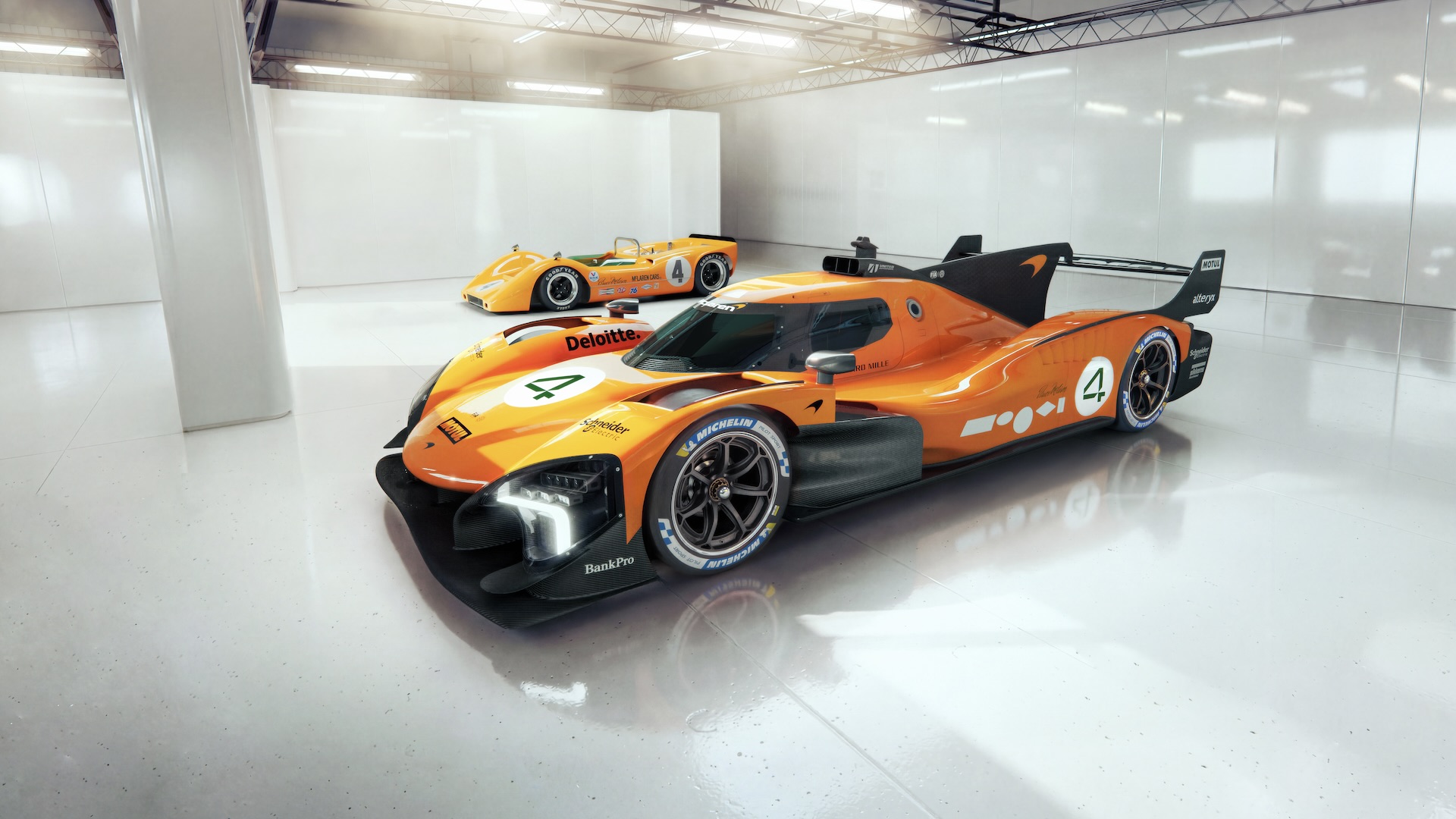
The MCL-HY is here. A 707-horsepower twin-turbocharged V6 hybrid prototype, wearing a searing papaya livery that nods to Bruce McLaren’s Can-Am car and points squarely at Ferrari’s current Le Mans dominance. Testing starts this month. The Triple Crown is the goal. The Woking faithful are unreasonably excited.
It is 1995. A bright orange McLaren F1 GTR, built for road use and adapted for racing in approximately forty-five minutes by anyone’s standards, wins the 24 Hours of Le Mans overall on its first attempt. Finish positions second, third, fourth and fifth also go to McLaren F1 GTRs. It is one of the more improbable results in motorsport history, delivered by a car that had no right to be at La Sarthe in the first place and absolutely every right to win. The last time McLaren entered a Hypercar-class machine at Le Mans was 1998. It is now 2026. The gap is long enough that Zak Brown has clearly decided that something needs to be done about it, and that something is the MCL-HY.
McLaren officially unveiled its 2027 FIA World Endurance Championship challenger on 4 May 2026, and the key details deserve stating clearly. A Dallara carbon fibre monocoque — as used by BMW and Cadillac on the current WEC grid — wrapped in McLaren-designed bodywork. A twin-turbocharged 2.9-litre V6 developed jointly between McLaren Racing and McLaren Automotive, producing up to 707 horsepower. A hybrid MGU system delivering up to 520kW to the rear axle. A minimum weight of 1,030 kilograms. Track testing commences this month. Homologation follows at the end of 2026. The WEC debut, including the 24 Hours of Le Mans, happens in 2027. And the livery, at least for testing, is papaya orange, in a shade that Top Gear described as searing and that we are inclined to agree with.
THE LIVERY AND THE HERITAGE IT CARRIES
The papaya livery is not simply a colour. It is a statement of intent delivered in approximately 800 millilitres of specifically mixed orange paint, and McLaren knows precisely what it is doing with it. The MCL-HY’s 2026 testing livery is inspired by the McLaren M6A — the 1967 Can-Am car with which Bruce McLaren himself dominated the series and which he envisioned converting into the M6GT road car, a project he intended to take to Le Mans before his death in 1970 ended those plans entirely. McLaren’s Instagram post at the reveal was explicit about this: after winning Le Mans in 1966 with Ford, Bruce McLaren went on to dominate Can-Am in 1967 in the M6A, and it was there that he first saw a road back to La Sarthe. The MCL-HY is positioned as the fulfilment of a dream that its founder never got to chase.
That is a great deal of history to put on a car that has not yet turned a wheel in anger. It is also entirely earned. McLaren’s record in sports car racing — Can-Am dominance through the late 1960s and early 1970s, and that improbable 1995 Le Mans win with a car that was essentially an extremely powerful road car with a roll cage — gives the MCL-HY a lineage that most of the current WEC grid can only admire from a distance. Ferrari won Le Mans last year. Toyota has been doing so regularly for years. Porsche has seventeen overall victories to its name and has just left the programme. Into this field steps McLaren, wearing its most historically loaded colour, with 31 years of accumulated motiviation.
THE TRIPLE CROWN
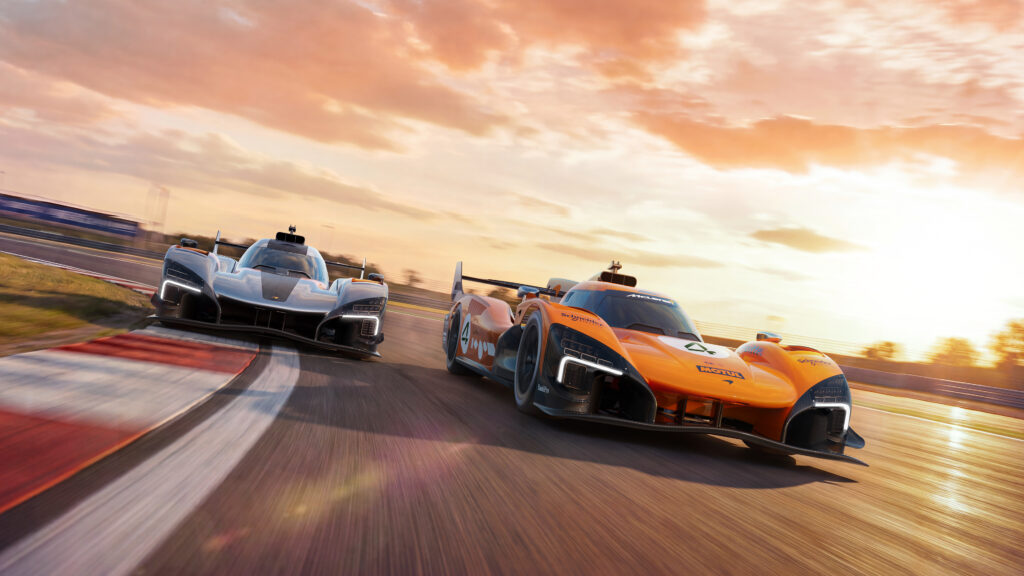
Zak Brown has been talking about the Triple Crown for some time, and the MCL-HY is the piece that makes the conversation serious. With McLaren already operating at the front of Formula 1 under Lando Norris and Oscar Piastri, and competing across the full IndyCar calendar, the addition of a Le Mans programme means McLaren is the only manufacturer currently active in all three series simultaneously. Brown has already confirmed that both Norris and Piastri have expressed interest in racing at Le Mans, which would add an additional layer of fascination to what is already an unusually compelling story. Whether the logistics of running an F1 title contender in a 24-hour race alongside a championship campaign can actually be made to work is a different question, and one Brown acknowledged requires careful management of the driver market.
The two MCL-HYs will be run by United Autosports, the British team that has been campaigning McLarens in WEC’s GT class for several years and therefore knows both the car and the championship rather better than most new entrants do. It is a sensible choice, and one that gives the programme a structural advantage that many manufacturer entries in their debut seasons conspicuously lack.
THE TEST DRIVERS
Mikkel Jensen, confirmed as the McLaren Hypercar Team’s works driver, will lead the 2026 test programme alongside three supporting drivers. McLaren Driver Development Programme members Grégoire Saucy and Richard Verschoor will contribute development miles, while Ben Hanley of United Autosports brings the kind of specific LMDh development experience that is extremely difficult to put a value on. The race driver lineup for the 2027 season itself has not yet been announced, with Brown indicating he wants to see how the wider driver market develops before committing.
THE MCL-HY GTR TRACK CAR
Alongside the race car, McLaren simultaneously revealed the MCL-HY GTR — a client track car based on the racing machine, built through a collaboration between McLaren Racing and McLaren Automotive that is described as the first of its kind. The GTR uses an uprated version of the same 2.9-litre V6, producing 720 horsepower, but dispenses with the LMDh hybrid system in favour of a lower dry weight and a focus on drivability for track day use. Between 30 and 35 examples will be built, offered exclusively to VIP McLaren clients through the Project: Endurance programme.
Ownership of the MCL-HY GTR is, by design, an experience rather than a transaction. Six private track sessions across international circuits over two years, driver coaching, pit crew support and engineering assistance are all included. MCL-HY GTR owners will attend the 2027 Le Mans 24 Hours with full VIP hospitality access and direct access to the McLaren Hypercar Team’s operation, experiencing every strategic decision as it unfolds. It is, in the most literal possible sense, a front-row seat to McLaren’s return to the top of endurance racing. Deliveries are expected to begin towards the end of 2027, following the racing debut of the competition car. It is the closest thing available to owning a piece of the programme without actually being Lando Norris.
REVMAG VERDICT
McLaren won Le Mans in 1995 with a road car. In 2027 it will return with a machine built specifically for the purpose, wearing papaya orange, run by a team that knows the circuit, powered by an engine developed in-house, and carrying the weight of a dream that dates back to Bruce McLaren himself planning to take his M6A to La Sarthe before he ever got the chance. The MCL-HY is not a publicity exercise. It is a proper, fully committed Le Mans Hypercar that will challenge Ferrari, Toyota and the rest of the current grid for outright victory. Whether it can win in its first season is a question nobody can answer yet. What is beyond doubt is that the field just became considerably more interesting. Testing starts this month. We will be watching every lap.