
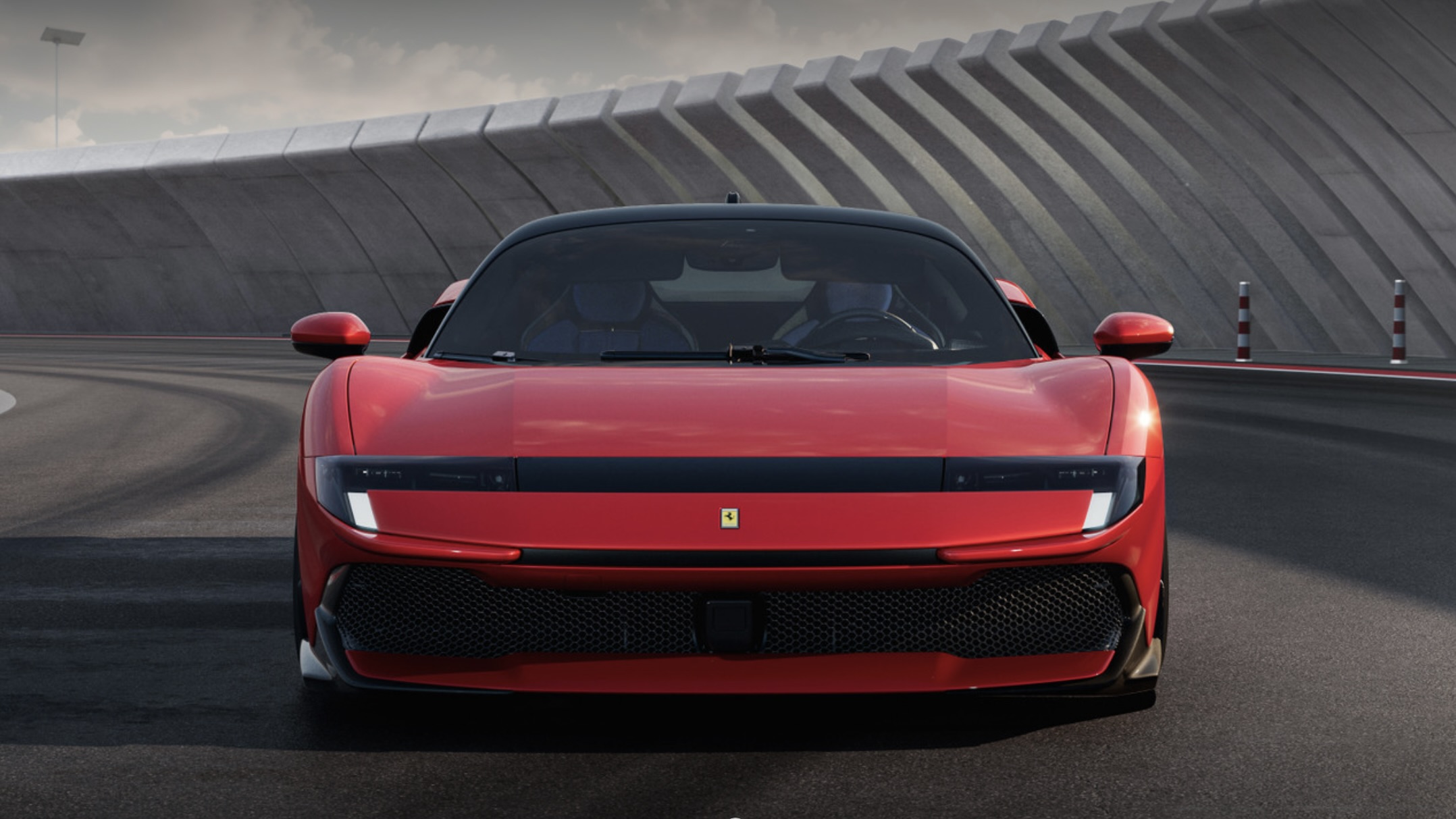
The 1984 Testarossa is a poster car, a cultural artefact, a Pininfarina masterpiece. The 2026 849 Testarossa is a 1,035 horsepower plug-in hybrid with three electric motors and a twin-turbocharged V8. One of these things is not like the other. And yet, Ferrari says it is perfectly justified. Let us examine this claim.
Right. Let us address this properly, because it deserves a proper address and not just a Twitter argument. When Ferrari announced in September 2025 that its new SF90 successor would be called the 849 Testarossa, the internet did what the internet always does: it split immediately into two camps, both absolutely certain they were correct, neither particularly interested in nuance.
Camp One said: this is a travesty. The Testarossa is one of the most beautiful cars ever made, a flat-twelve-engined Pininfarina sculpture that defined an era, that sat on the bedroom walls of an entire generation, that still commands enormous money at auction and boundless reverence everywhere else. You cannot put that name on a plug-in hybrid with a turbocharged V8 and three electric motors. You simply cannot. It is like calling a new album Sergeant Pepper’s. It might be brilliant, but it is not that.
Camp Two said: calm down. Testa Rossa means red head. It refers to the red-painted cam covers of Ferrari’s most extreme racing engines. Ferrari first used the phrase on the 500 TR in 1956. It is not a shape. It is not a body style. It is not a Pininfarina design language. It is a descriptor of mechanical intent, a statement that what lives under the bonnet is serious beyond all normal measure. And by that definition, a twin-turbocharged V8 making 830 horsepower before you add three electric motors contributing another 220 horsepower has red cam covers in every sense that matters.
Both camps have a point. The situation is more interesting than either of them is allowing.
WHAT THE NAME ACTUALLY MEANS
Ferrari’s justification, stated plainly on their own website, is this: the name Testa Rossa was first applied to the 500 TR in 1956 to describe the colour of the cam covers on some of Ferrari’s most extreme, high-performance racing engines. It was a working description before it was ever a proper name. The 1984 road car borrowed that description and turned it into an icon. But the icon was built on top of a much older tradition, and Ferrari’s argument is that the 849 belongs to that older tradition rather than being a sequel to the 1984 car specifically.
This is technically correct. It is also, as Ferrari’s chief engineer Raffaele de Simone might put it, complex without being complicated. The engineering argument is sound. The emotional argument is harder to win, because emotions are not interested in engineering arguments and the 1984 Testarossa gave an entire generation of people an emotional response that no amount of correct-ness can easily override.
WHAT THE 849 ACTUALLY IS
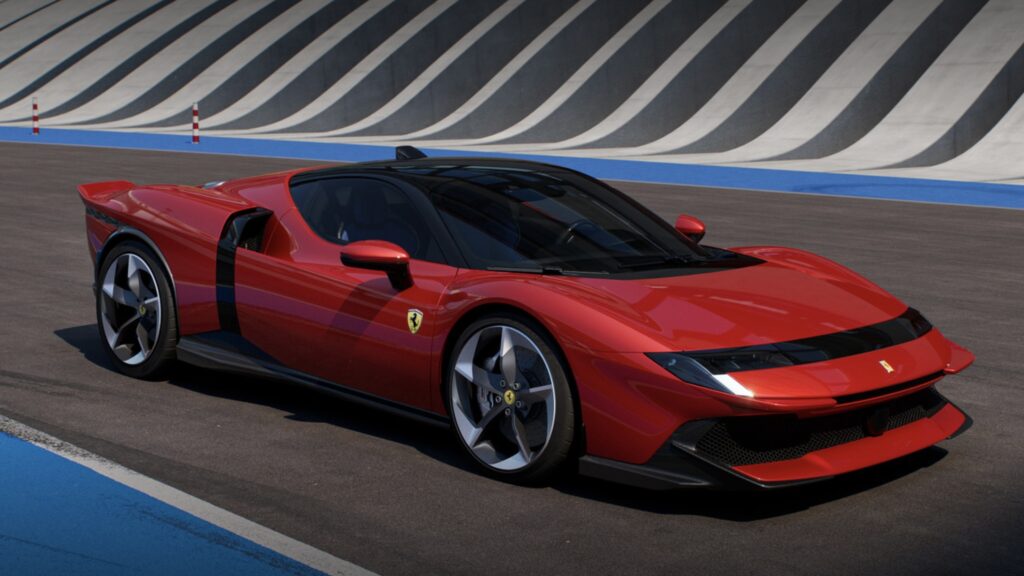
Here is where the conversation needs to shift from the name to the car, because the car is, by every objective measure, extraordinary. The 849 in the name is not arbitrary: the 8 refers to its eight cylinders, and the 49 refers to the displacement of each cylinder in cubic centimetres. This is Ferrari’s way of encoding the car’s mechanical identity into its designation, which is either charmingly nerdy or deeply pretentious depending on your tolerance for Italian automotive philosophy. Personally, I am entirely in favour of it.
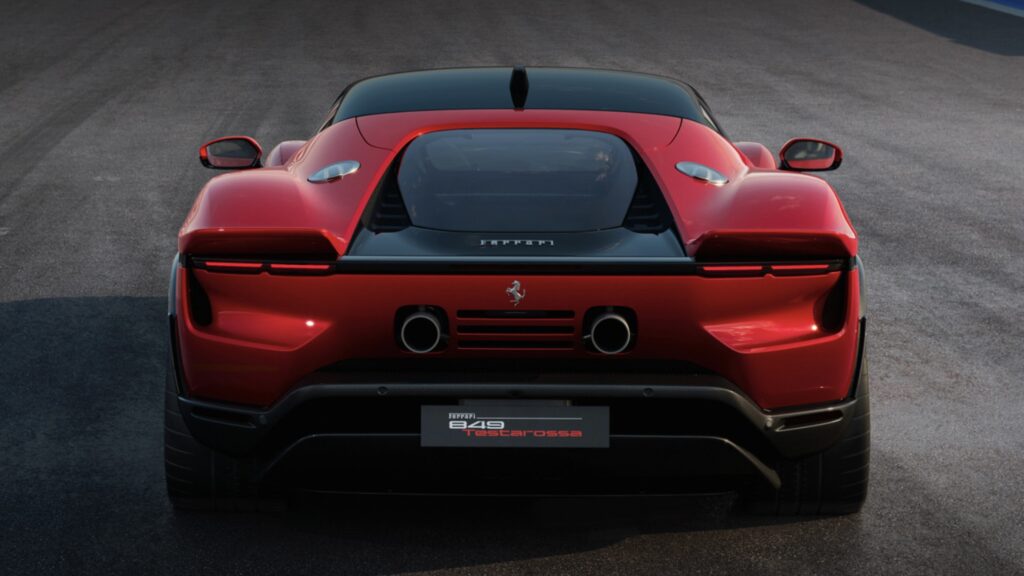
The engine is a 4.0-litre twin-turbocharged V8 producing 830 horsepower on its own, fitted with the largest turbochargers ever installed on a production Ferrari road car. Add the three electric motors — two at the front axle running Ferrari’s RAC-e torque vectoring system, one at the rear derived directly from Formula One — and the total combined output reaches 1,035 horsepower. It covers 0 to 62mph in 2.3 seconds. It reaches 205mph. It laps Ferrari’s Fiorano test track in 1 minute 17.5 seconds, which is a full second and a half faster than the SF90 it replaces and a mere two-tenths behind the track-focused SF90 XX. It generates 415 kilograms of downforce at 155mph. Its rear-end design, specifically the twin-tail architecture, is inspired by the 1970 Ferrari 512 S endurance prototype. Its rear downforce is produced with ten percent less drag than the SF90 managed.
In other words, this is not a car that has borrowed a famous name to disguise mediocrity. It is a car that has borrowed a famous name because it believes, with some justification, that it has earned it.
THE LEGITIMATE GRIEVANCE
And yet. The people who are upset about the name are not simply being irrational, and it would be dismissive to say they are. The 1984 Testarossa was not just mechanically significant. It was visuallysignificant in a way that very few cars in history have managed. Sergio Pininfarina and his team created something that felt genuinely new at the time, something that did not look like anything else on the road, and that has aged with the particular dignity of designs that were so right for their moment that they remain right for every moment since. Those side strakes. That width. Those rear haunches. The way it looked parked. The way it looked moving. The way it looked on a poster in 1986 at seven years old and the way it still looks now.
The 849 Testarossa does not look like that. It looks like a very aggressive, very modern Ferrari, influenced in its design language by the F80 hypercar and the 1970s racing prototypes. Chief Design Officer Flavio Manzoni is, by all accounts, pushing Ferrari’s design vocabulary into somewhere bold and new. Top Gear noted that its launch was met with mild bemusement at the name and then, pointedly, a lot of regret that Pininfarina is no longer in charge of the colouring-in at Maranello. That is a sentence that deserves sitting with for a moment. A lot of regret that Pininfarina is no longer in charge. There are people at Ferrari who will find that sentence uncomfortable, and they should, because it contains a truth worth confronting.
The 849 has styling elements that nod, subtly, to its predecessor. A gloss black trim connecting the headlights, echoing the original’s sidepod intakes. The twin-tail rear. Certain proportions at the flanks. But these are nods rather than conversations, and the internet — which grew up with the original on its walls — wanted a conversation.
THEN YOU DRIVE IT
Here is the thing, though. Autocar drove it and called it a significant course correction, turning what the SF90 was — a QR code on a table, a technical exercise — into a handwritten menu, a car with genuine warmth and personality. That is not a small thing for a hybrid hypercar. Hybrid hypercars are, as a category, often competent in ways that are profoundly unsatisfying. The SF90, brilliant as it was on paper, was precisely that: fast because it had almost a thousand horsepower and four-wheel drive, rather than fast in the way that makes you want to ring someone immediately and tell them about it.
The 849, every serious road test suggests, is different. The biggest turbochargers ever fitted to a production Ferrari, new cylinder heads, titanium fixings throughout, a fully Inconel exhaust, and a gear-shift strategy borrowed from the SF90 XX specifically designed to generate a more exciting sound on upshifts. Ferrari has apparently heard the criticism that hybrid V8s sound like an appliance, and has gone to considerable lengths to address it. They have also, according to Autocar, succeeded. The engine revs to 8,300rpm. The sound, apparently, is immersive in ways that the SF90 was not.
So here is where we land. The name is divisive and the division is completely understandable. The 1984 Testarossa cast a very long shadow and the 849 does not look like it belongs in that shadow. Ferrari’s justification, rooted in the 1956 racing heritage, is historically correct but emotionally unconvincing to anyone for whom the name means a flat-twelve and a poster. Both of these things can be simultaneously true. What is also true is that the car itself, beneath whatever name it is wearing, appears to be one of the most genuinely satisfying Ferraris made in years. Which, if you are Ferrari, is probably the only argument that ultimately matters.
| 1984 TESTAROSSA | 2026 849 TESTAROSSA |
| The Icon | The Successor |
| Flat-12, naturally aspirated, 428cv | Twin-turbo V8 + 3 electric motors, 1,035hp |
| Pininfarina. Wide strakes. Poster-grade beauty. | Flavio Manzoni. 512S-inspired. Divisive but bold. |
| 0 to 62mph: 5.8 seconds | 0 to 62mph: 2.3 seconds |
| Top speed: 180mph | Top speed: 205mph |
| Price in 1984: approx. £50,000 | Price in 2026: from £407,617 |
| Reaction: universal adoration | Reaction: complicated |
REVMAG VERDICT
The name controversy is real, legitimate, and ultimately beside the point. Ferrari has taken the most emotionally loaded badge in its history and attached it to a car that is faster, more powerful and more technically advanced than anything that has ever worn it. Whether that justifies the name depends entirely on whether you believe heritage is about mechanical philosophy or visual identity, and reasonable people will disagree. What is not in dispute is that the 849 Testarossa is an extraordinary machine that appears to have solved the problem the SF90 never quite could: being genuinely involving to drive, not just genuinely fast. If it has to borrow a name to get your attention long enough for you to discover that, perhaps Ferrari has made its peace with the trade-off. Production begins mid-2026. It will sell out immediately. The arguments will continue considerably longer.