
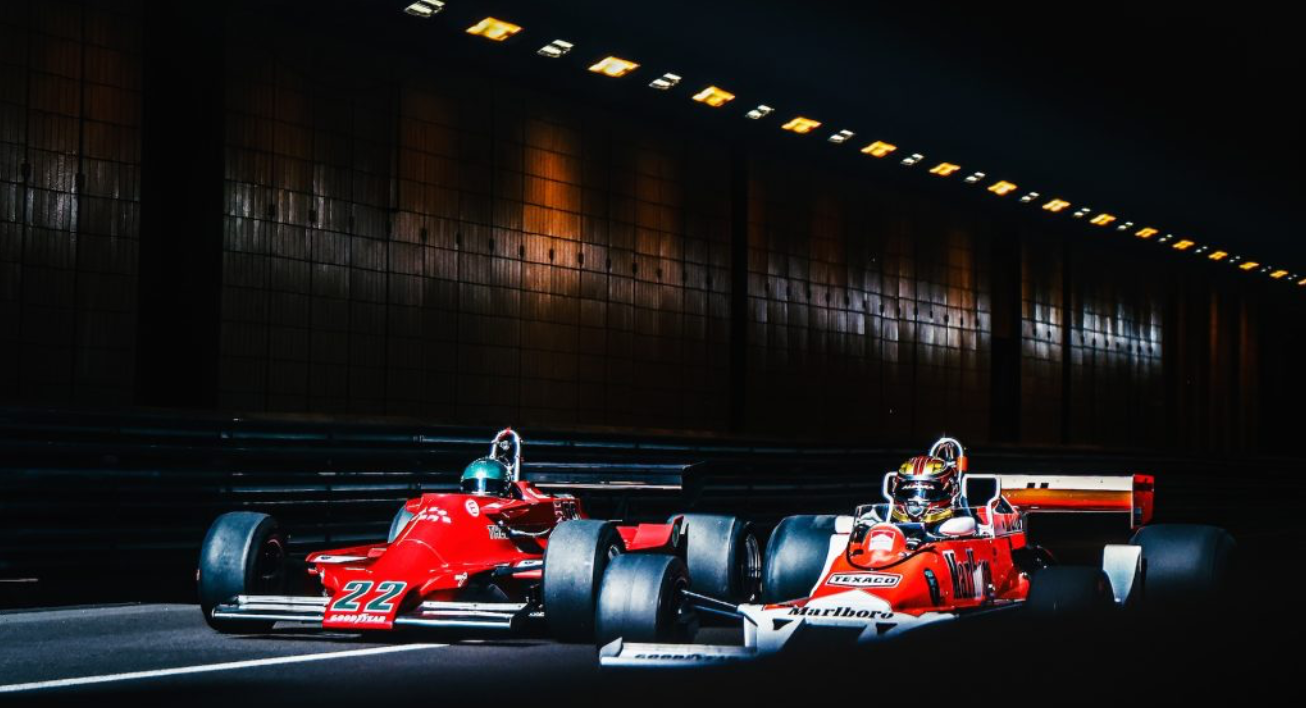
Let’s get something straight from the outset. The Grand Prix de Monaco Historique is not about speed. Not really. It’s about watching cars that have absolutely no business going fast anymore hurl themselves around streets so narrow that modern F1 drivers break into a cold sweat, driven by people who clearly never received the memo about taking it easy with irreplaceable machinery. It is, in short, magnificent. And the 2026 edition — the 15th, since you ask — was one of the best.
Eight races. Record crowds. At least one retirement that will haunt a man’s dreams, one soaking wet Rascasse, and two drivers who appeared to be operating in a completely different postcode to everyone else on track. Stuart Hall and Michael Lyons each won twice. The rest of the field merely provided context.
HOW THE DAY UNFOLDED
The morning started with Series A2, where Mark Shaw delivered what the official reports described as a “commanding performance.” In historic motorsport language, this usually means he got a gap early and then simply refused to give it back, which is entirely the correct approach when you are driving something that costs more to insure than most people’s houses. Shaw’s win set an early tone of controlled authority, a tone that the weather would later make entirely irrelevant.
Series A1 gave us the first genuine drama of the day, which arrived, as drama typically does at Monaco, on the final lap. Richard Bradley had led for the vast majority of the race, presumably feeling quite pleased with himself. Then his car retired. On the last lap. In Monaco. With the finish line in sight. There is a particular cruelty to motorsport that no other sport quite manages, and this was it delivered in concentrated form. Patrick Blakeney-Edwards, who had presumably been waiting patiently behind for exactly this sort of development, inherited the win.
The Series B race produced the battle of the weekend, a three-way fight that apparently kept spectators on the edge of their seats for the duration. Eventually, the Ferrari of Joseph Colasacco emerged victorious, which is as it should be. A Ferrari winning in Monaco feels cosmically correct in a way that is difficult to argue with.
Series D, meanwhile, brought the weekend’s most dispiriting story. Jean Alesi — yes, that Jean Alesi, the man who once did things in a Ferrari at Monaco that made grown adults cry — was unable to start after a mechanical failure that extensive overnight repairs had failed to cure. There are very few things sadder in motorsport than a racing driver standing next to a car that will not start. Alesi, who has spent his entire career extracting the maximum from whatever machinery he was handed, deserved better from his machinery this weekend. The race itself went to Michael Lyons, who began building what would become a very impressive personal tally.
HALL, THE RAIN AND LA RASCASSE
By the time Series E arrived, the weather had decided to join the conversation. Rain fell, and it fell specifically at La Rascasse, the slow right-hander at the bottom of the circuit where the barriers are close, the grip is minimal, and the consequences of misjudgement are immediate and expensive. Multiple drivers, it is reported, found this out. Stuart Hall did not. Hall, demonstrating either exceptional car control or an unusual relationship with good fortune, capitalised on the chaos and took his first win of the weekend under yellow flag conditions. He did not look like a man who had merely survived. He looked like a man who had planned it.
Richard Wilson handled Series C with a controlled display that suggested he had decided to leave the drama to everyone else, which on this particular Sunday was entirely possible. His win was a study in doing precisely what was needed and nothing more, a skill that is considerably harder than it looks in Monaco, where the walls are always approximately twelve inches closer than your brain tells you they should be.
Lyons returned to the top step in Series F, completing his double. Two races, two wins, no fuss. There is something deeply satisfying about watching a driver in complete harmony with their car on a circuit that punishes the slightest lapse of concentration, and Lyons managed to make it look straightforward, which it was not.
THE FINALE
The final race of the weekend — Series G — provided the fittingly dramatic full stop. There were interruptions, because of course there were; Monaco does not do quiet finales. Through whatever the interruptions were, Stuart Hall held his nerve, managed the situation, and took his second win of the event to complete a double of his own. Two winners, four wins between them, and a day that confirmed everything the Historic Monaco Grand Prix has always been about: extraordinary cars, extraordinary drivers, and a circuit that has not changed in any meaningful way since drivers first flung themselves around it in 1929 and found it completely terrifying. It still is. They still do. Long may it continue.