
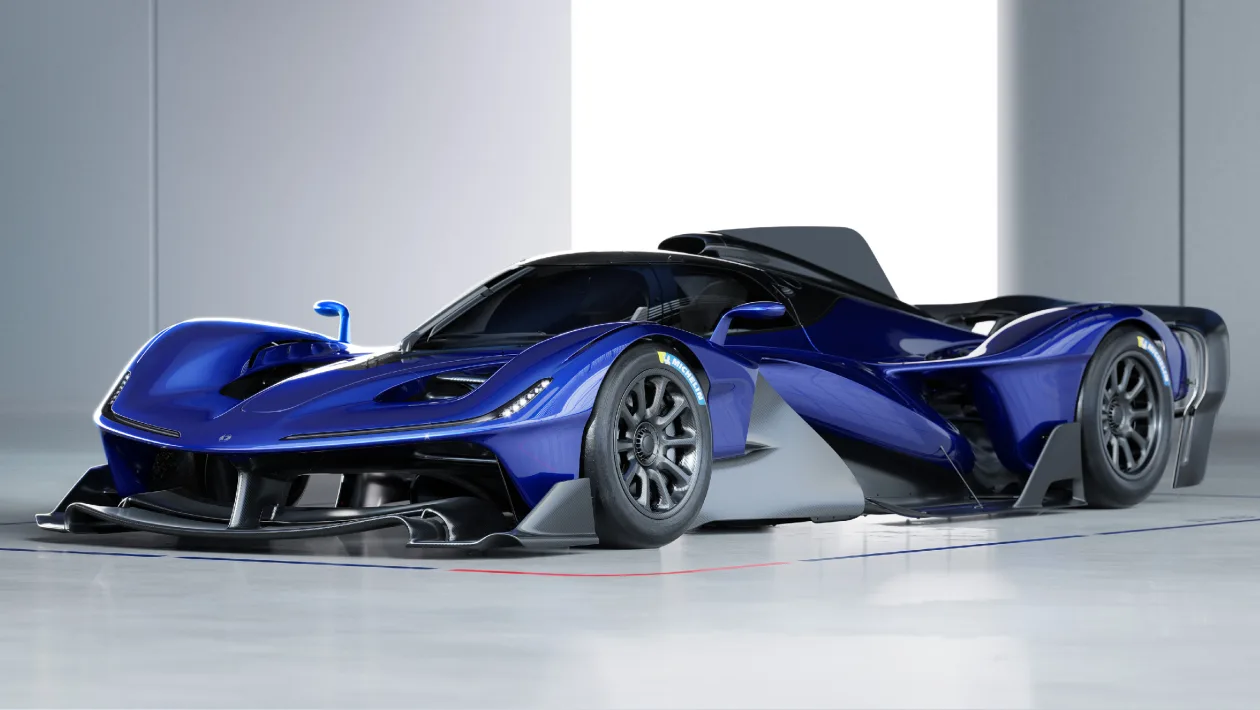
There is a moment, when you first properly look at the Red Bull RB17, when your brain quietly requests a second opinion. It doesn’t look like a road car. It doesn’t look like a race car. It looks like something that escaped from a wind tunnel at three in the morning and nobody’s quite managed to catch it yet. And that, it turns out, is entirely the point.
This is Adrian Newey’s masterwork. Not a collaboration, not a compromise, not a “we had to meet regulations in seventeen different countries” exercise. The RB17 is the true full expression of Newey’s and Red Bull Advanced Technologies’ engineering and design vision, unrestricted by road or race regulations. He started sketching it at Christmas 2019. He drew the aerodynamic surfaces by hand. By hand. In 2026. The man designs the world’s most advanced racing cars with a pencil and the sheer force of a very large brain.
The concept appeared at Goodwood in 2024, a non-running styling buck that caused sufficient excitement to make grown men weep into their Pimm’s. Now, eighteen months later, we have the production body, and in a video shot by Top Gear we get to hear the 15,000rpm 4.5-litre V10 scream for the first time.
Let’s talk about what’s actually in it, because the numbers are frankly offensive. The 4.5-litre V10 — built by Cosworth — produces 1,000 hp, and an electric motor adds another 200 hp. Combined total: 1,200 horsepower. Weight? Under 900 kilograms. To put that in perspective, a Mazda MX-5 weighs more. The RB17 weighs less than a Mazda MX-5 and has twelve times the power. Think about that for a moment. Take your time.
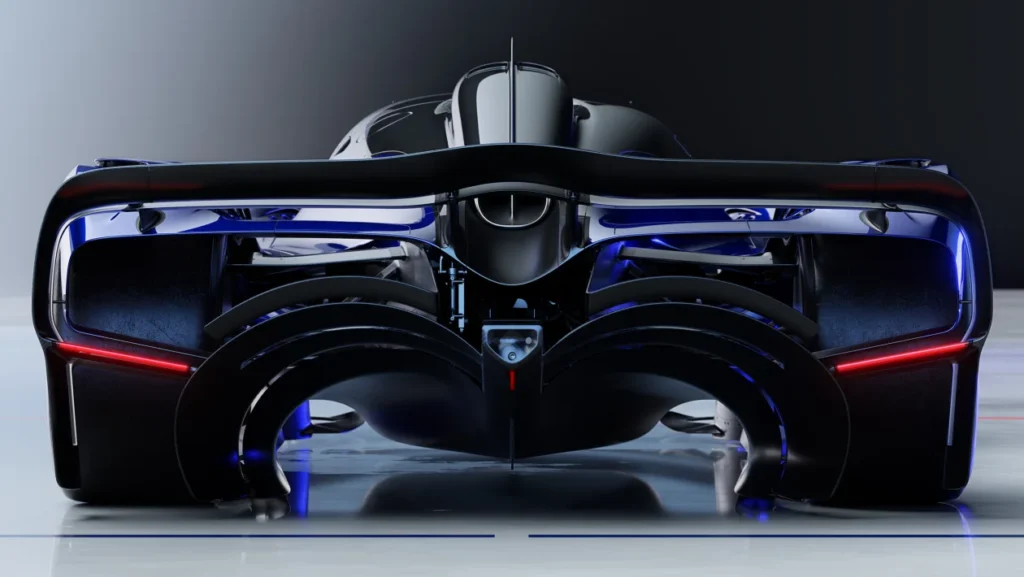
The exhaust is a 10-into-one setup, inspired by Newey’s own 2000 McLaren MP4/15, a car he considers the best-sounding F1 car ever made. One of his last design changes was to move the exhaust outlet onto the spine of the engine cover, which sounds elegant until you discover it led to an enormous amount of work on the thermal side of things. To stop bits catching fire. Typical. Absolutely typical.
Thanks to its sculptured bodywork, wings, intakes, splitter and diffuser, Red Bull says the RB17 should be able to generate up to 1,700kg of downforce and top out at 350km/h. There’s also F1-inspired adjustable push-rod suspension, motorsport-derived carbon-ceramic brakes and the choice of three specially developed Michelin tyres, including the option of full slicks. The steering is fully hydraulic, essentially an F1 car’s system. And it seats two people, which is almost comically civilised given everything else about it.
Newey has said that in the hands of a professional driver, the car is capable of F1 lap times. Not F1-inspired lap times. Not “surprisingly competitive” lap times. Actual F1 lap times. Around Silverstone, Spa, Suzuka. This is a car a paying customer could theoretically use to go faster around a Grand Prix circuit than Max Verstappen. The implications of that sentence take a few minutes to properly land.
How much? £5 million, roughly $6.7 million, plus taxes. All 50 have already been allocated. Of course they have. Technically only 49 are available, because Newey has reserved one for himself. Which, honestly, seems only fair. You design a 1,200 horsepower V10 hypercar that weighs less than a hot hatch and makes F1 lap times, you’ve earned the right to keep one.
Physical track testing is getting underway this year, and the car is expected to appear at a Grand Prix before the end of the season. The thought of hearing a 15,000rpm naturally aspirated V10 howling around the Silverstone pitlane on a Thursday practice day is enough to make your eyes water with pure, uncomplicated joy.
The Aston Martin Valkyrie, itself one of the most extraordinary machines ever built, was once considered the zenith of what was possible when F1 thinking met a road car brief. Newey was involved in that too, of course. But the Valkyrie was a collaboration, a compromise, a thing constrained by the demands of road legality and the practicalities of Aston Martin’s somewhat turbulent existence. The RB17 has none of those constraints. It exists only to be the fastest, most engaging, most sonically overwhelming track experience that human engineering can currently produce.
It is, in short, completely and utterly magnificent.
Verdict: 1,200 horsepower. 900 kilograms. 15,000rpm. No rules. No excuses. No equal.