Ferrari has officially revealed the name of its first fully electric car — the Ferrari Luce — and with it, one of the most ambitious interior redesigns in the brand’s history.
While the exterior will not be shown until later this year, Ferrari has lifted the curtain on the cabin first. And it is no ordinary Ferrari interior. The Luce’s cockpit has been developed in collaboration with LoveFrom, the design studio founded by former Apple Chief Design Officer Sir Jony Ive and long-time collaborator Marc Newson — the duo responsible for shaping the look and feel of the iMac, iPhone and Apple Watch.
This is not simply a Ferrari going electric. It is Ferrari rethinking how a driver interacts with a car.
A Human-Centred Ferrari
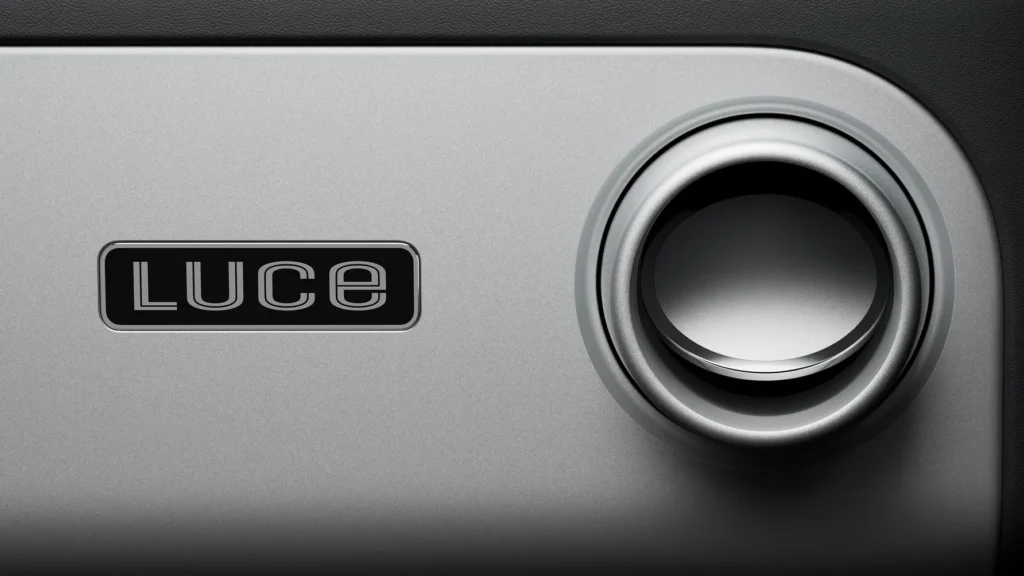
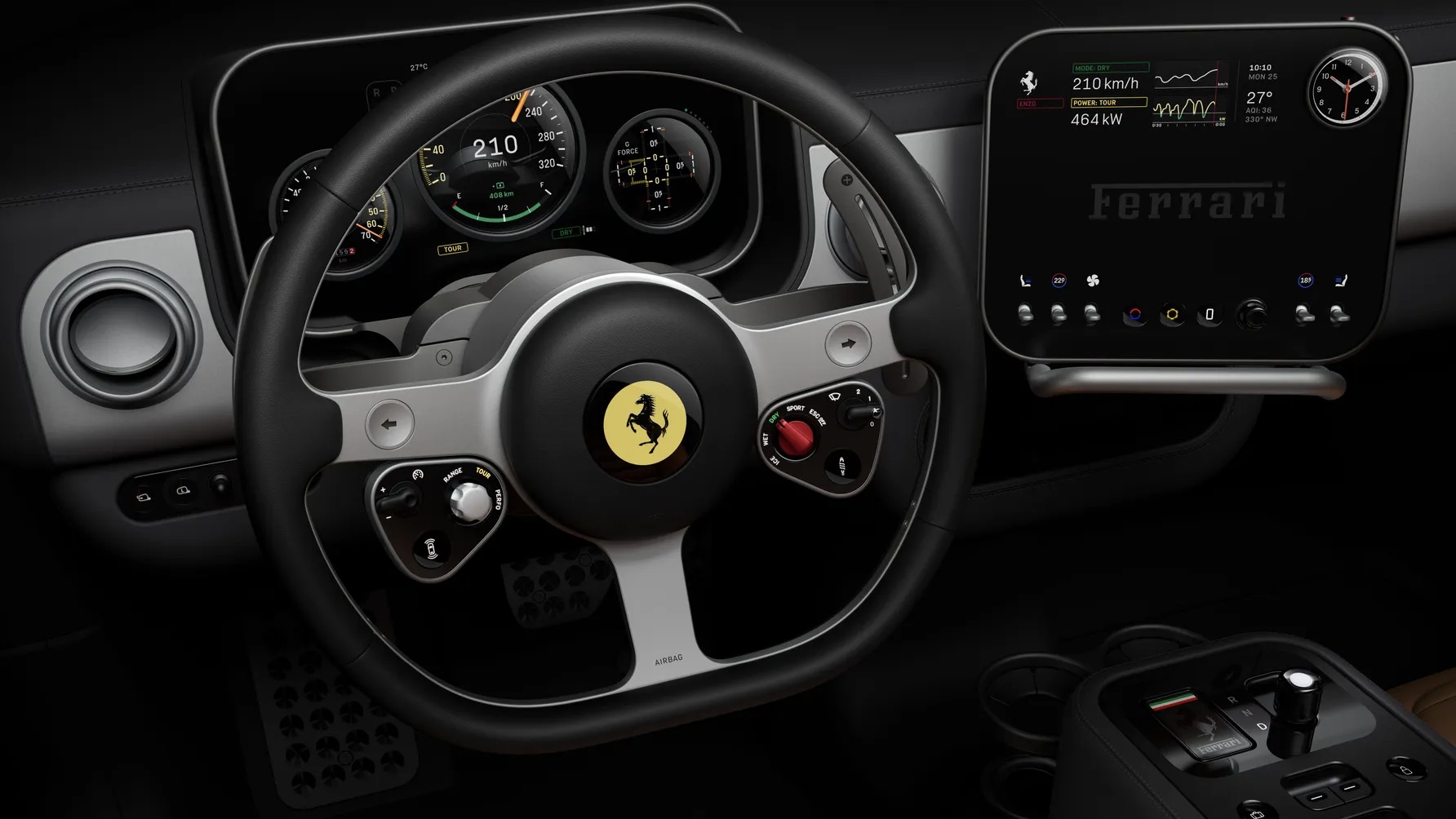
At first glance, the Luce’s interior appears deceptively restrained. A central digital binnacle, a three-spoke steering wheel and a standalone infotainment display sit within an aluminium architecture that feels sculptural rather than decorative. Four precision-machined air vents punctuate the dashboard. There is no visual clutter.
But behind that simplicity lies obsessive engineering.
Sir Jony Ive described the project as an effort to combine the clarity of analogue interfaces with the power of digital displays. The steering wheel and instrument cluster were designed as a unified system — output and input working together. All primary controls are physical and mechanical. No touch-sensitive gimmicks on the wheel. No vague haptic guesswork.
Ferrari’s engineers, Ive noted, were instrumental in translating design philosophy into functional reality. Ergonomics were refined according to first principles: what is essential to drive, and what merely distracts?
Aluminium, OLED and Aviation Inspiration
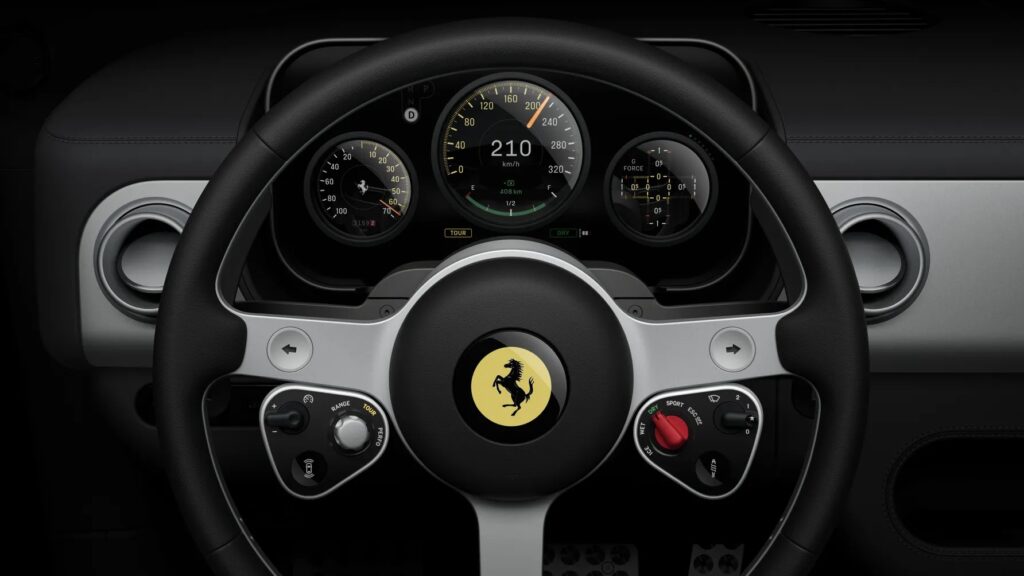
The Luce’s 12.86-inch instrument binnacle is sculpted from anodised aluminium and designed to invite tactile interaction. Even unseen components are CNC-machined from solid billets, emphasising durability and precision. Plastic is notably absent.
The steering wheel itself is constructed from 19 separate CNC-machined parts, made from a specially developed 100 percent recycled aluminium alloy. Beneath its main spokes sit two control pods: on the right, a rotary dial adjusts the Luce’s electric power modes; on the left, a reinterpreted manettino configures chassis settings.
Paddle controls manage regenerative braking and what Ferrari calls “Torque Shift Engagement” — a system designed to simulate stepped acceleration.
The digital instrument graphics take cues from classic Veglia and Jaeger Ferrari gauges, but are powered by advanced OLED technology developed in collaboration with Samsung. Each pixel can switch independently, delivering perfect blacks and high contrast. A physical aluminium needle, backlit by 15 LEDs, overlays the digital display — a hybrid analogue-digital solution intended to reduce cognitive load while preserving visual drama.
Avionics and vintage helicopter instrumentation reportedly influenced the dial layout, reinforcing the car’s aviation-inspired precision.
A Screen That Moves — And A Glass Console Like No Other
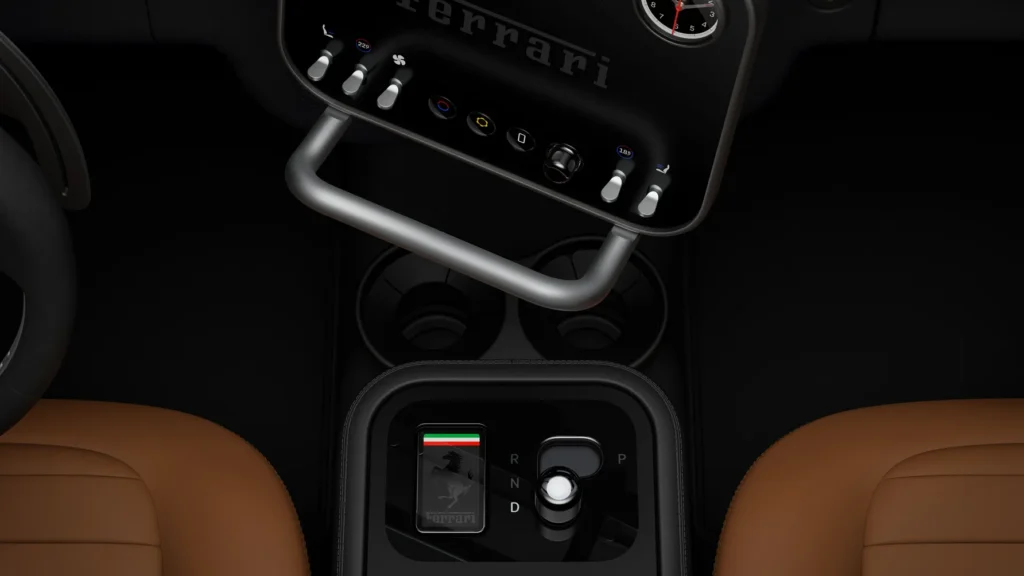
The 10.12-inch central display sits on a ball-and-socket mount, allowing it to pivot smoothly toward either driver or passenger. A dedicated palm rest prevents awkward jabbing at the screen.
Physical climate controls remain, reflecting LoveFrom’s belief that tactile switches outperform purely digital solutions.
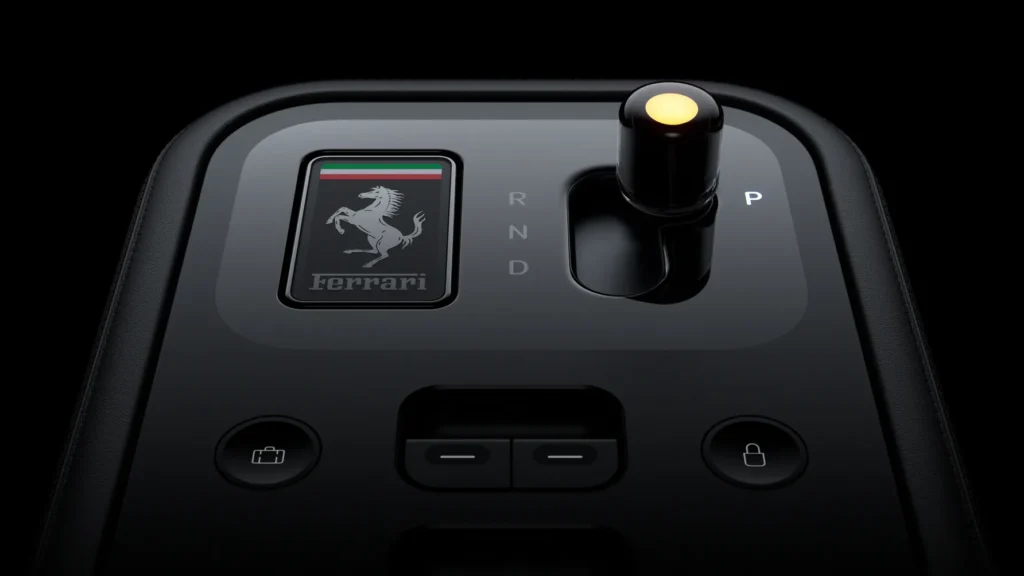
The centre console introduces an innovative glass panel developed with Corning, Apple’s long-time materials partner. Using laser-drilled micro-perforations, graphics are embedded into semi-matte glass designed to resist fingerprints.
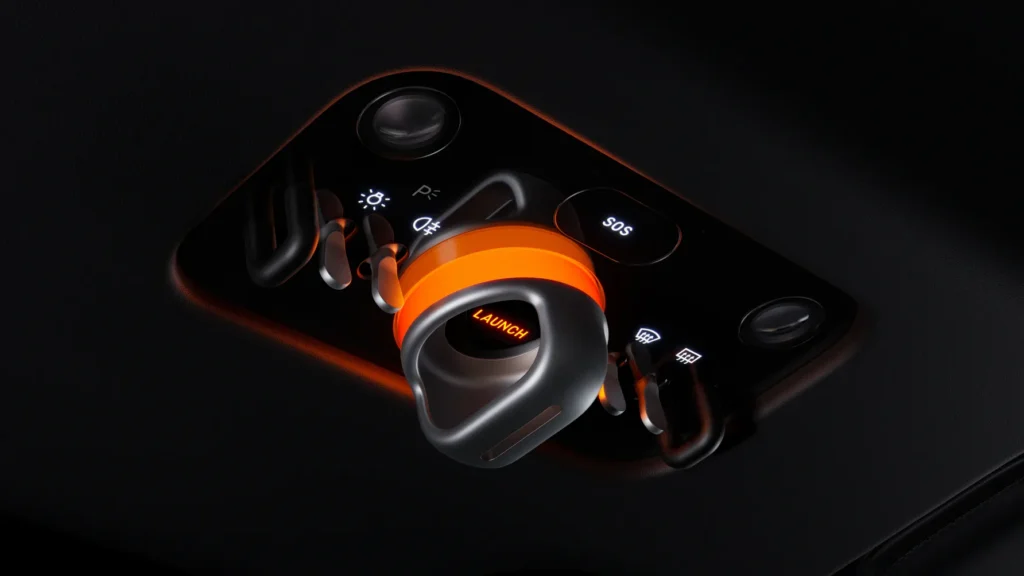
The key itself sits in a magnetic dock beside the shifter. Inserted into place, its signature Ferrari yellow transitions to black using e-ink technology, triggering an orchestrated lighting sequence across the displays.
It is subtle theatre — a reminder that even in an electric Ferrari, drama remains essential.
More Than an ‘Elettrica’
Ferrari executive chairman John Elkann confirmed the car will not carry the name “Elettrica,” stating that the Luce represents something broader than a simple drivetrain shift.
Chief Design Officer Flavio Manzoni described the collaboration with LoveFrom as a rare opportunity for cross-pollination between consumer electronics and automotive engineering — a generational design moment comparable to Ferrari’s stylistic evolution in the 1960s and 1970s.
The broader market question — whether ultra-high-performance EVs can command traditional Ferrari demand — remains open. But inside the Luce, Ferrari is clearly betting on timeless materials, mechanical tactility and architectural clarity rather than disposable digital trends.
Consumer electronics are often associated with rapid obsolescence. Ferrari’s aim, according to Elkann, is the opposite: to create something that will endure.
The Ferrari Luce is expected to debut fully later this year, marking one of the most significant transitions in the company’s history.
For Ferrari, the search for soul in the electric age begins not with silence — but with design.