
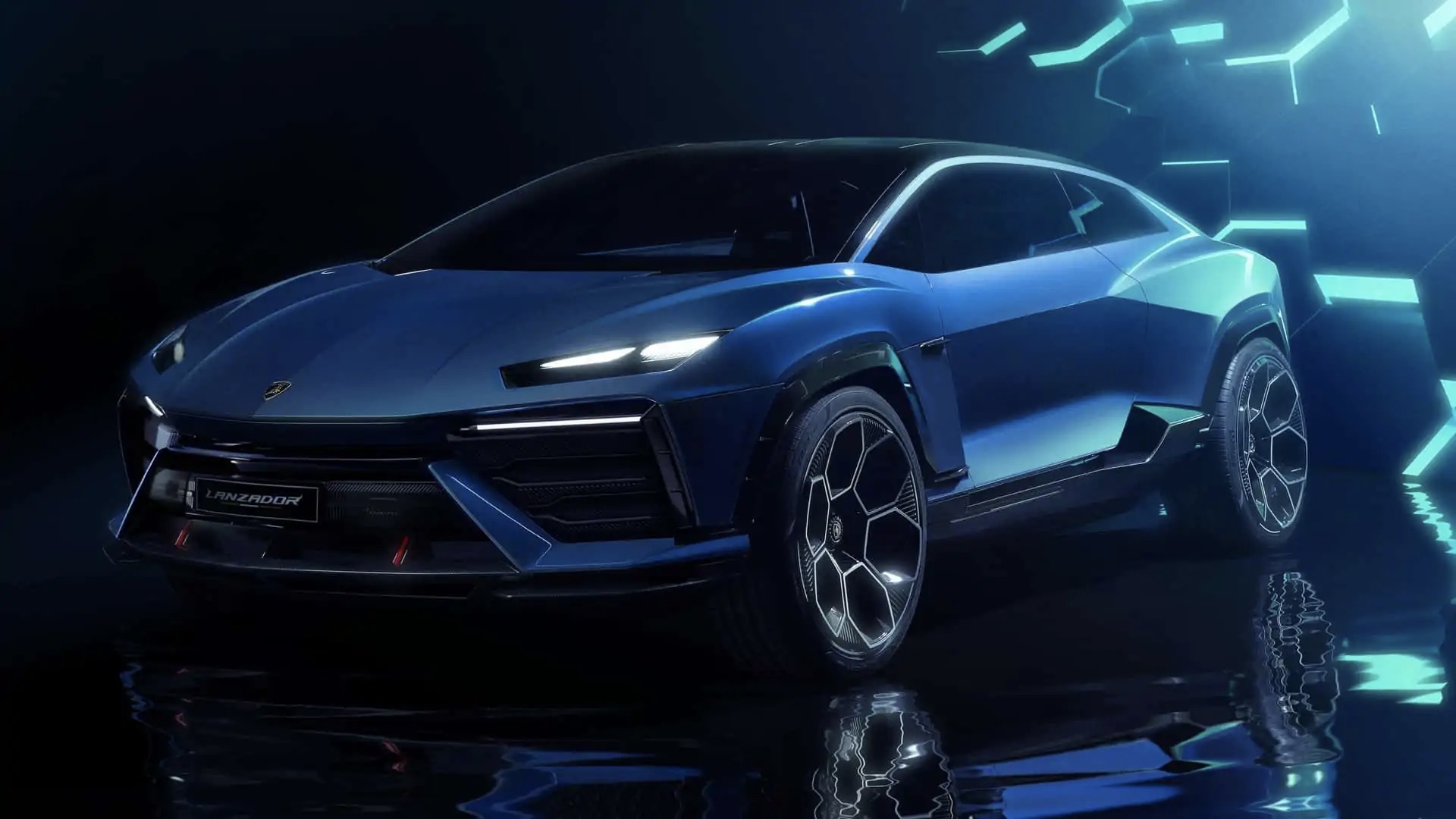
Lamborghini has officially pushed back the launch of its first fully electric production car to 2029, confirming that the Italian supercar brand is in no rush to embrace full electrification. The decision positions Lamborghini in stark contrast to rivals such as Ferrari, which is preparing to unveil its first electric vehicle in 2025.
Speaking earlier this week, Lamborghini CEO Stephan Winkelmann explained that the luxury sports car market is not yet ready for an all-electric Lamborghini — particularly in a segment where emotion, sound and driving character remain central to the brand’s identity.
“We don’t believe that 2029 is too late to introduce an electric Lamborghini,” Winkelmann said. “We don’t think the market in our segment will be ready in 2025 or 2026.”
Lanzador Concept Still Defines Lamborghini’s Electric Vision
Lamborghini first previewed its electric future with the Lanzador concept in August 2023, presenting it as a high-performance electric GT rather than a traditional low-slung supercar. The concept featured a raised driving position, all-wheel drive and a power output exceeding 1,000 kW (1,360 hp), signalling a new category for the brand rather than a direct replacement for its V10 or V12 models.
At the time, Lamborghini indicated that production would begin in 2028. That timeline has now shifted to 2029, reflecting broader uncertainty around EV adoption — even at the top end of the performance car market.
Unlike Ferrari’s upcoming EV, which is widely expected to debut as a large, high-performance electric crossover or SUV, Lamborghini’s Lanzador is positioned as a lifestyle-oriented electric GT, aimed at preserving the emotional appeal of the brand while adapting to future regulations.
Hybrid First, Electric Later
Rather than rushing into full electrification, Lamborghini is doubling down on hybrid technology. The brand already offers three plug-in hybrid models: the Urus SE, the V12-powered Revuelto, and the new V8 Temerario. These models form the backbone of Lamborghini’s transitional strategy, allowing it to reduce emissions without abandoning combustion engines entirely.
Winkelmann also pointed to regulatory uncertainty in Europe as a factor. The European Union plans to review its proposed 2035 ban on combustion engines in 2026, while discussions around synthetic fuels as a viable alternative to battery-electric vehicles are ongoing.
Is the Luxury Sports Car Market Ready for EVs?
Lamborghini’s stance may raise eyebrows, particularly given the existence of electric hypercars such as the Rimac Nevera and Aspark Owl, as well as electric grand tourers like the Porsche Taycan, Lotus Emeya and Maserati GranTurismo Folgore.
However, Lamborghini’s leadership argues that its customers — and its brand — operate under different expectations. While electric performance is no longer in question, emotional engagement remains a challenge, especially for marques built on sound, drama and heritage.
More broadly, the global EV market has shown signs of slowing, with declining demand in Germany and stagnation across parts of Europe. Lamborghini appears content to wait out market volatility rather than commit prematurely to a technology cycle that may evolve significantly before the end of the decade.
The Bottom Line
Lamborghini isn’t rejecting electric vehicles, it’s redefining when and how they make sense for the brand. By delaying its first EV until 2029, the company is betting that patience, not speed, will ultimately protect its identity in a rapidly changing automotive landscape.